
South Carolina Measles Outbreak: How Falling MMR Vaccination Rates Triggered a Preventable Crisis

South Carolina is experiencing a significant measles outbreak driven by declining MMR (measles, mumps, rubella) vaccination rates. With kindergarten vaccination coverage falling below the 95% threshold required for herd immunity, the state is seeing the predictable consequences of under-vaccination. This post explains what caused the outbreak, what measles actually does, how rare serious MMR vaccine side effects are, and how mixed federal messaging has shaped public response.
What Is Happening in South Carolina?
South Carolina’s 2024–2025 kindergarten MMR vaccination rate dropped to approximately 91%, below the 95% community immunity benchmark required to prevent sustained transmission. This highlights the common misconception that public health policy on vaccinations should not merely be a “personal choice”.
The outbreak has been particularly concentrated in the Upstate region.
Why Did Vaccination Rates Fall?
Several measurable factors contributed:
Rising Religious Exemptions
Religious exemptions in the Upstate have increased sixfold over the past decade.
More than 13,000 students were using exemptions by fall 2024.
Spartanburg County has seen exemptions triple.
Some schools report vaccination rates as low as 20%.
When vaccination rates cluster below herd immunity levels, measles spreads rapidly.
Misinformation and Public Health Mistrust
The decline in MMR vaccination rates did not happen in isolation. Over the past several years, skepticism toward public health institutions has increased across the country.
Several dynamics have contributed:
The COVID-19 pandemic intensified scrutiny of public health agencies, leading some individuals to generalize distrust from COVID policy debates to routine childhood vaccines.
Social media platforms have amplified unverified claims about vaccine ingredients, long-term side effects, and government transparency.
Anecdotal stories — often emotionally powerful but scientifically unrepresentative — circulate widely and can outweigh population-level data in public perception.
Confusion about vaccine schedules, booster recommendations, and evolving COVID guidance has blurred distinctions between well-established childhood vaccines like MMR and newer vaccines.
The MMR vaccine has been in use since the early 1970s and is supported by decades of clinical data. However, online discourse frequently treats it as though it were newly introduced or insufficiently studied.
When repeated claims — even if inaccurate — are presented confidently and often enough, they can reshape risk perception. For many parents, the question is no longer “Is measles dangerous?” but rather “Is the vaccine riskier than the disease?” That inversion reflects the power of narrative over statistics.
Vaccination, which was once broadly understood as a shared public health responsibility, is increasingly framed in some communities as an individual lifestyle choice. When vaccination shifts from collective norm to personal preference, herd immunity erodes.
“Collective Amnesia”
Measles was declared eliminated in the United States in 2000 because of the efficacy of the MMR vaccine. That success dramatically reduced public exposure to the disease.
For parents born after widespread vaccination campaigns, measles is often an abstract concept — something mentioned in history books rather than something witnessed firsthand.
Most adults today have never seen:
A child hospitalized with measles pneumonia.
A case of measles-related encephalitis.
The long-term neurological devastation caused by Subacute Sclerosing Panencephalitis (SSPE).
Without lived experience, perceived risk declines.
When a disease disappears from daily life, urgency fades. Vaccination becomes seen as optional rather than protective. The visible absence of disease paradoxically weakens the motivation to prevent it.
This phenomenon has been described as a form of “collective amnesia.” The very success of vaccination programs can obscure the severity of the diseases they prevent.
When immunity rates fall below herd immunity thresholds, the consequences reappear quickly.
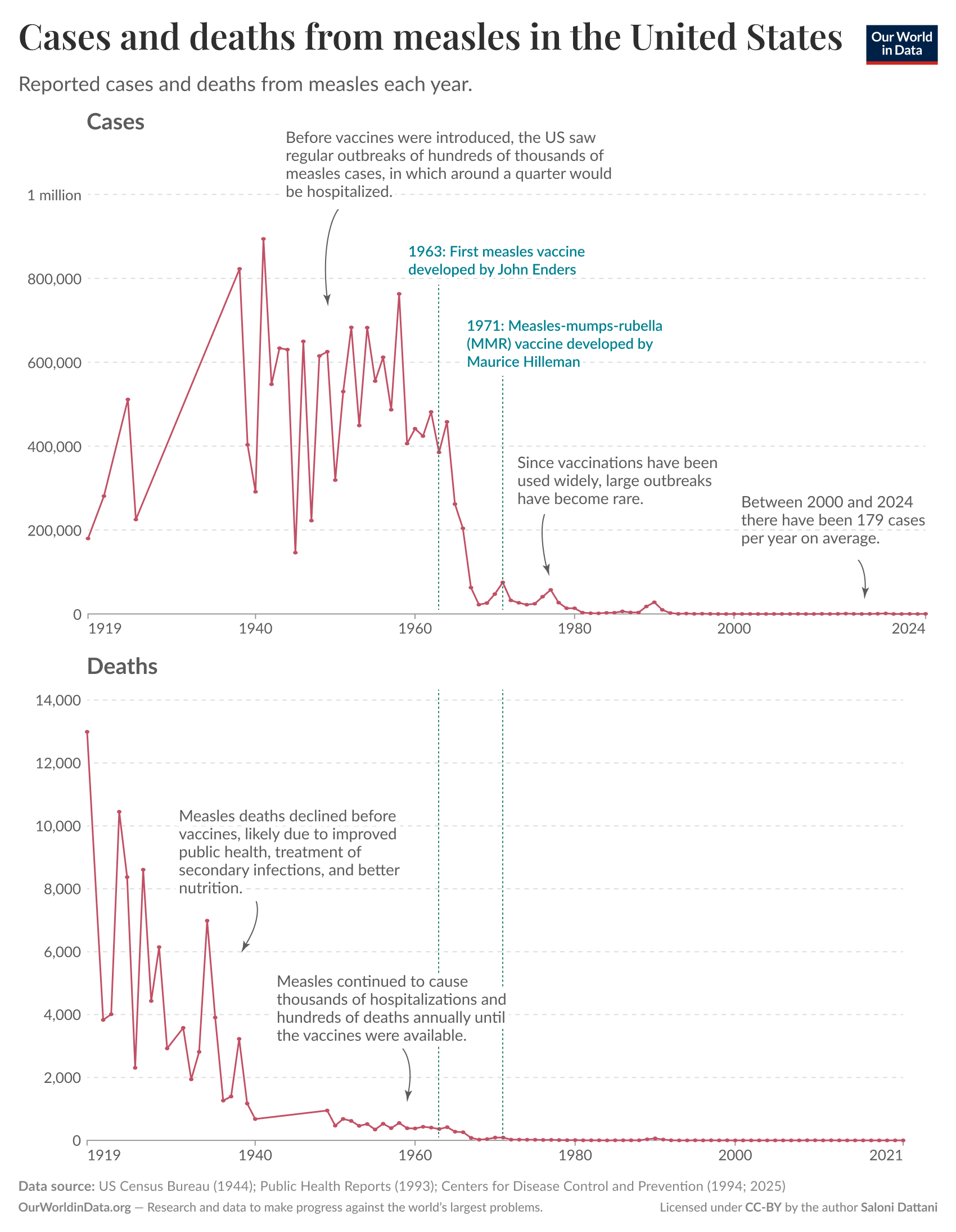
[Source: https://ourworldindata.org/measles-increases-disease-risk]
Access Barriers
In addition to hesitancy and misinformation, practical barriers also play a role.
In some rural and underserved areas:
There are shortages of primary care physicians.
Pediatric appointments may require long travel times.
Clinics may have limited vaccination hours.
Some families lack reliable transportation.
Healthcare systems may struggle with staffing or vaccine supply consistency.
Even modest logistical friction can reduce vaccination rates when combined with uncertainty or skepticism.
Public health compliance is strongest when vaccines are:
Easily accessible,
Clearly recommended,
Socially normalized,
And reinforced by consistent messaging.
When access is inconsistent and messaging is mixed, vaccination rates become more vulnerable to decline.
How Dangerous Is The Measles Virus?
Measles is one of the most contagious viruses known. In unvaccinated populations, one infected person can transmit the virus to 12–18 others.
Common Symptoms
According to the CDC:
High fever
Cough
Runny nose
Red, watery eyes
A spreading rash
Serious Complications
Respiratory Complications
Pneumonia affects approximately 1 in 20 infected children.
It is the primary cause of measles-related death.
Other respiratory complications include bronchiolitis, laryngitis, and croup.
Neurological Complications
Acute encephalitis occurs in approximately 1 in 1,000 cases.
It can cause seizures, permanent brain damage, and deafness.
A rare, fatal long-term complication — Subacute Sclerosing Panencephalitis (SSPE) — can develop years after infection.
Immune System Suppression
Measles can cause “immune amnesia,” weakening the immune system and increasing susceptibility to other infections for months or years.
Pregnancy Risks
Infection during pregnancy increases the risk of premature birth, low birth weight, and fetal death.
Mortality
Historically, 1 to 3 in 1,000 infected children die from measles complications.
How Rare Are Serious MMR Vaccine Adverse Events?
The MMR vaccine has been studied for decades across millions of doses.
Febrile seizures occur in approximately 1 in 3,000–4,000 doses.
Serious central nervous system complications such as encephalitis or meningitis occur in approximately 1 in 1,000,000 doses.
Serious adverse events from the MMR vaccine are rare and significantly less frequent than the risks associated with natural measles infection.
Vaccination decisions should be grounded in peer-reviewed research, efficacy testing, long-term safety monitoring, and scientific expertise — not social media narratives, opinions of pundits, or politicians with no medical or scientific background, experience or knowledge.
Federal Messaging During the Outbreak
The measles outbreak has occurred amid mixed federal messaging signaling that CDC and HHS are sending competing, contradictory and confusing messaging on vaccinations. Should parents vaccinate their kids with the MMR vaccine? Is it a personal choice? Does the vaccine wane over time and become ineffective? Is the MMR vaccine safe?
RFK Jr. on Waning Immunity
“Part of that is that there are people who don’t vaccinate, but also the vaccine itself wanes,” he said, of why there are outbreaks every year. “The vaccine wanes about 4.5% per year. So that means older people are essentially unvaccinated. They aren’t — their immune system is not protected.”
RFK Jr. on Vaccine Adverse Events
“There are adverse events from the vaccine,” Kennedy said in a March 11 interview with Fox’s Sean Hannity. “It does cause deaths every year. It causes — it causes all the illnesses that measles itself causes, encephalitis and blindness, et cetera. And so people ought to be able to make that choice for themselves.”
RFK Jr. on Vaccine Testing
“Right now we don’t know the risks of many of these products because they’re not safety tested,” Kennedy told CBS News. “Many of the vaccines are only tested for three or four days with no placebo group.”
RFK Jr. on Personal Choice
“I’m a freedom-of-choice person,” Kennedy told Fox News host Sean Hannity during an interview in March. “We should have transparency. We should have informed choice, and if people don’t want it, the government shouldn’t force them to do it.”
Dr. Mehmet Oz on Vaccination
“Take the vaccine, please. We have a solution for our problem,” Oz said. “Not all illnesses are equally dangerous, and not all people are equally susceptible to those illnesses. But measles is one [where] you should get your vaccine.”
What This Outbreak Tells Us
The South Carolina measles outbreak is not mysterious.
It reflects:
Declining MMR vaccination rates
Increased exemption use
Concentrated under-vaccinated communities
Public confusion about risk
Mixed health messaging
Measles does not require political controversy to spread. It requires opportunity — one that has not snuck up on American public health officials.
The current outbreak in South Carolina is not an isolated event. Measles cases have been increasing in the United States over the past several years.
In 2019, the U.S. recorded more than 1,200 measles cases — the highest number in decades — driven largely by outbreaks in under-vaccinated communities. Although case counts declined during the height of the COVID-19 pandemic due to reduced travel and social interaction, cases began rising again as routine vaccination rates fell.
By 2022, measles outbreaks were again being reported across multiple states. In 2024, national case counts had already surpassed the total reported in 2022 by early spring. Multiple separate outbreaks were documented that year, many associated with communities where MMR vaccination coverage had dropped below herd immunity levels.
Early 2025 case totals have already exceeded the prior year’s numbers, with the overwhelming majority of infections occurring in individuals who were unvaccinated or whose vaccination status was unknown.
Public health officials have warned that declining childhood vaccination rates and increasing exemption use are creating immunity gaps in certain communities. When measles is reintroduced through travel or exposure, those gaps allow the virus to spread quickly.
The pattern is clear: as vaccination rates decline, outbreaks follow.
Final Perspective
Vaccines are one of the most effective public health tools ever developed.
Measles is a preventable disease with well-documented complications.
Choosing to vaccinate is often described as a matter of personal choice. But infectious disease does not operate on an individual level. When vaccination rates decline, the consequences extend beyond a single family. Measles spreads rapidly in communities with pockets of under-vaccination. Infants too young to be vaccinated, individuals with compromised immune systems, and others who cannot receive vaccines for medical reasons become vulnerable when herd immunity weakens.
When reputable, peer-reviewed scientific evidence is disregarded under the banner of “personal choice,” the result can be predictable and severe. The risk of serious adverse events from the MMR vaccine is rare. The risk of measles infection and its complications in an under-vaccinated population is significantly higher.
Public health functions best when messaging from the CDC, HHS, and state health departments is clear, cohesive, and grounded in science. Vaccination policy should not be partisan or divisive. Viruses do not distinguish between political identities or cultural viewpoints.
Clear, science-based communication — grounded in evidence and free from distortion — is essential to maintaining public trust and protecting communities.
Understanding risk accurately, rather than rhetorically, is what prevents the next outbreak, keeps our communities safe and our children safe.